
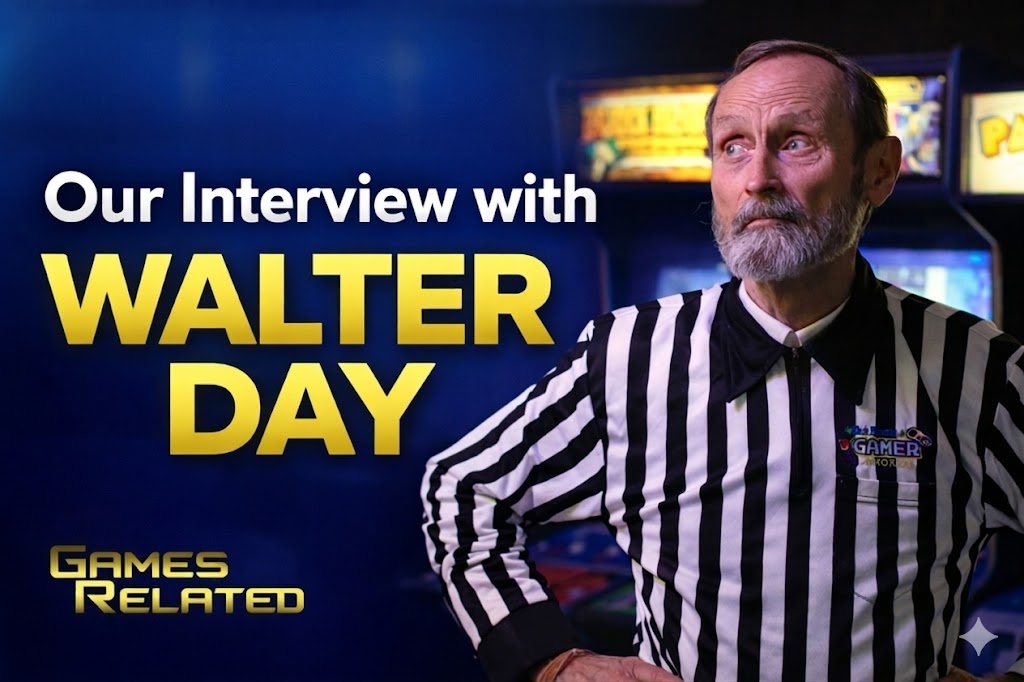

Whether he’s in his iconic black-and-white referee stripes or meticulously verifying a world record, Walter Day is the undisputed “Patriarch of Video Gaming.” As the founder of Twin Galaxies and the artist behind Arcades and Love Songs, Day didn’t just track high scores; he turned competitive gaming into a global phenomenon long before “esports” was a household term. In this exclusive interview, we sit down with the man who lived through the golden age of the arcade to discuss the birth of competitive play, his legendary role in the King of Kong era, his new film and album Arcades and Love Songs, and a variety of other topics, including stories that have never been told.
My first question is really something I’ve always wondered. You talk about how you got into games early and you were hooked. What was the first game you ever played, and where did you see it?
Walter Day: In 1972, on the campus of Maharishi International University, they had a Pong machine. I tried it, and I wasn’t very good at it. I found it difficult and didn’t enjoy it. So, I dismissed video games as being something that I’m never going to be interested in.
But then, I guess it was May or June of 1980, while working as an oil broker in Houston, Texas. I wasn’t doing very well making oil deals. This other person who was also from Fairfield, Iowa, and was also in Houston in the oil industry—we decided to fund an idea of mine, which was to produce a “Who’s Who in the Petroleum Industry” and have biographies of important oil executives.
We started working on it for maybe a month before we finally said one night, “Boy, I’m tired of this. I can’t work on any more oil executives tonight. I have to go play Space Invaders.”
I said, “What is Space Invaders?”
He took me to this arcade that was on the big freeway loop around Houston—I think it was called 410 or 610. There was a big Malibu Grand Prix there. We went in there, and I was in my first arcade. The first thing I saw was a whole bank of Berserk machines, all shouting “Kill the humanoid.” He took me past that and led me to Space Invaders. Before the night was over, I was hooked on Space Invaders. I fell in love with playing video games.
But what really interested me were the crowds of people that would gather around people playing video games who were doing really well, showing skill in action. Many people who have heard me talk before know that I talk openly and very supportively about my practice of Transcendental Meditation. Most people don’t realize that it’s not a philosophy or religion or a psychic thing. It is an actual practice that you do. You sit down in a comfortable chair, close your eyes, and for 20 minutes you think this mental technique.
When you do that, your mind and body slip into a unique state of consciousness that’s different from anything you’ve ever experienced in your life. The scientists who have measured this call it a “hypometabolic state of restful alertness.” In that state, you have all sorts of different brain waves going on, alpha waves and stuff like that. By doing this regularly over time, stress relieves your nervous system, your head becomes clearer, your mind becomes smarter, you become more creative, happier, and your enzymes become balanced in your physiology. You start excelling more and more.
When I saw people who were definitely superior video game players, I thought, “What is the parallel between that and Transcendental Meditation? What qualities are they unfolding that are making them better than the best?” I started becoming aware of that and thinking about excellence in action and who the champions were, and what level of consciousness they were exhibiting that would have been similar to the pure consciousness developed when you practice Transcendental Meditation.
Very few people were the champions. There would be crowds around individuals, but very few individuals would be champions. But what was it that made them special? That was the thing that hooked me on high scores and champions. What is it that makes them better than the best, and what kind of level of consciousness are they dipping into? It’s similar to that level of consciousness that everybody who practices Transcendental Meditation reaches.
I really thought a lot about how Transcendental Meditation makes champions. Out in the countryside, all you’ve got is what you were born with. But with Transcendental Meditation, you can unfold all that hidden potential and become a champion if you practice TM regularly for years.
Essentially, I started becoming intrigued by the champions of the video game world. A little bit later, when I stopped being an oil broker, I went on the road as a traveling salesman selling old newspapers from the day you were born. I had hundreds of thousands of old newspapers dating back as far as the year 1590. I had huge piles of Civil War newspapers, 1790s newspapers, and 1660s newspapers. I used to sell them to high school teachers.
But on the road as I traveled, I’d stop in every arcade I could because I was so in love with playing video games. I played the games there, but also, I became fascinated with the high scores that I would see on the games everywhere. I would start writing down the high scores until I had all sorts of notes. Like in Emporia, Kansas, I saw a score of 504,000 on Tempest. I thought, “Wow, is that the highest score ever?”
I’d write them all down. I would never have names to attribute them to, so they were throwaway scores, but they were benchmarks for what the highest score on each game was. I was intrigued by that. So by the time I opened up Twin Galaxies, I had a lot of notes.
Richard Booth: So you had the idea of high scores before you even opened the arcades?
Walter Day: I had all sorts of notes on high scores before I even opened the place. It was already percolating in my awareness to do the scoreboard without even realizing what was happening.
Richard Booth: Wow, okay.
Walter Day: So I put a scoreboard up. We started having a scoreboard of our local scores up on the wall. And then, on January 18th, 1982, Time magazine came out with a cover story that said something like “Video Games Take Over the World.” In that eight or nine-page article, there was one little story box. It was a story of Steve Juraszek of Chicago, who had put a quarter in a Defender game and played it for 15 straight hours, then just quit the game and walked away from it.
So all over the world—at least all over America—people were noticing that and saying, “I can beat that.” In my arcade too, someone walked up to me and said, “I can beat the score that’s in the magazine.”
I said, “What magazine?” because I hadn’t seen it.
He said, “This magazine,” and showed it to me. There I read the box about Steve Juraszek, and in my mind, this was a superstar in this magazine. He says, “I can beat that.” I looked at him in disbelief because it was too unbelievable that someone in my own small-town arcade could beat a nationally celebrated score. He says, “I can do it.”
I said, “Okay, prove it.”
That weekend, we set the Defender game aside for him. He went 23 hours for 24 million, or he went 24 million for 23 hours—I can’t remember which it was.
Richard Booth: And who was that?
Walter Day: His last name was Maturna, I think. It’s been 45 years almost. I’ll remember his name before the interview goes over.
Richard Booth: No problem.
Walter Day: So essentially, when he passed the score that was in the Time magazine, I called the local radio station and told them, “Look what’s happening.” They got excited about it and started covering his progress as non-stop news releases and updates as the night went on and became one in the morning, two in the morning.
I called the newspaper, and a reporter came early in the morning and started sitting there beside him watching him, getting ready to report it and write it up. Then I called the TV station, and they came over at night. So radio, TV, and newspaper—and then it really got my mind blown when suddenly we started getting calls from Kansas City, St. Louis, Peoria, Chicago. The story somehow in that late night was beginning to go through the wire stories. UP or UPI released it regionally. Lots of media was covering it.
It was a big news story because it was “Man vs. Machine.” The new age of teenagers facing off with the new age of technology. It was a big deal.
By the time Monday morning came around, I’d been interviewed a lot. I called up Williams Electronics to ask them, “Is this the highest score?” And they said, “We don’t know. No one keeps track of the records.”
I said, “Oh, really?” So I called Replay Magazine. They said, “We don’t know. No one keeps track of the scores.” I called Play Meter. They said, “We don’t know. No one keeps track of the records.”
So then I called Nintendo and Atari. I called seven manufacturers and those two magazines, and they all said, “We don’t know what the high scores are on any games because no one keeps track of the records.”
I was amazed by that. I thought about it all night. Then spontaneously the next day, just out of some sort of inspiration, I called back all nine of those phone calls. I looked up the scoreboard we had on the wall and said very assertively, “We have a scoreboard here, and we’re keeping track of the records. So if anybody needs to know what the high scores are, here’s our phone number.”
They said, “That’s incredible.” And all of them unanimously, all nine of them, through a miracle of divine fate—no one challenged me. They all said, “Good. Give us your phone number.”
Then a couple of them said, “Who are you?” Off the top of my head, I said, “We’re the Twin Galaxies National Scoreboard.”
It was born on that spot. Replay Magazine challenged me and said, “How are you going to make money off this?” I said, “I don’t think we’re going to make money off this. We’re doing this because it’s a service and it’s fun.” He said, “Oh, that’s good.” He was always a supporter of ours after that for 40 years.
I did those nine phone calls, and then I went back to playing Gorf. I was involved in a furious game of Gorf when suddenly one of our arcade attendants tapped me on the shoulder and said, “Someone’s on the phone with a high score.”
I went to the phone and looked at the clock. It had only been 30 minutes since I had made those phone calls. It was a guy named Casey Murphy from Goodlettsville, Tennessee, calling up to report a score on Galaga. It turns out that right after I had hung up with Midway, he had called Midway, and the lady apparently said, “Oh, wait a minute. I have a phone number for you. We just got it. Here’s the place to call.”
So he called me, and I looked up at our scoreboard. Our night attendant who does the night shift had a higher score. So I told him in a very solemn voice, “You, sir, have the second-highest score in the nation.” He got all excited. “Oh, I can beat that, I can beat that.” And within a couple of days, he had beat it.
Within weeks, we were getting 15 calls a day. Within months, we were getting 75 calls a day. Then Video Games Magazine and Joystick Magazine both contacted me and said, “We want your scoreboard as an exclusive.” I told both of them no. “No one’s getting it as an exclusive. This is a service for the whole world, and no one owns this.”
So they both respected that, and they both started carrying the Twin Galaxies National Scoreboard as a regular feature in their magazines, with the name of our arcade, the mailing address, my name, and our phone number on where to report scores and how to contact us.
It’s a bigger explanation than expected.
Richard Booth: Fantastic. You know, I don’t think I’ve ever heard it explained that well before to anybody. I didn’t take the time or bother to explain it out in detail like that. So you have a special gift for you.
Walter Day: Thank you.
Richard Booth: That is fantastic. Now, this kind of leads me into another one. I was under the understanding all these years that you had one arcade, but in Arcade and Love Songs, Steve Sanders mentioned that you owned two arcades. Is that accurate?
Walter Day: At the time that Twin Galaxies was a big hit, I also owned a second arcade in Kirksville, Missouri, which was 60 miles south across the border. It was a bigger arcade, a better arcade, a more beautiful arcade with more games, and a huge college base—like 9,000 or 11,000 college students. I think Indian Hills in Ottumwa only had like 1,200 students or something like that.
Originally, we planned to have the Video Game Capital of the World and the Dodge City of Video Games—as those concepts began to grow in my brain—happen in Kirksville because it was a more prestigious and more profitable venue than the Ottumwa one.
So I started getting ready to do the Video Game Capital of the World in Kirksville, not Ottumwa. Suddenly, Life Magazine called us. It turned out that at that time in 1982, the video game industry had begun to recognize us as the most formal platform or crossroads for the world of video game players. The industry was just interested in selling the games; we actually represented the gamers in a loose, general sense.
So they began to refer interesting inquiries to me. One of those interesting inquiries was from Life Magazine. They said, “Oh, you need to contact Walter Day because he represents the players.” They called me and explained that they were about to publish the 1982 Year in Review magazine, and it was going to be the January 1983 issue. They hadn’t decided what the theme was going to be, all they knew was that video games were a real big deal and it was going to be featured in the magazine.
So I said to them, “Why don’t you come here to Ottumwa, which is like the crossroads of the video game age? It’s the Mecca of video game players, the Dodge City of video games. I’ll bring all the top players of this era, and you can photograph them all here at Twin Galaxies, the most famous arcade in the world.”
They debated this and kept having meetings and kept getting back to me. They didn’t doubt what I said; it’s just that they didn’t necessarily decide at that time if they wanted to do that as their story. They still had enough evidence to show that Twin Galaxies was indeed the premier arcade in the world.
After about four phone calls, they finally said, “Okay, Mr. Day, we’re coming to Iowa.” We were interested in having your video game players pose for a picture.
I had to get the video game players to come, as I had promised Life Magazine. So I explained to Life Magazine that a lot of these kids are teenagers. We have to prove to their parents that this does involve Life Magazine and that this is safe and they’re not being lured into some sort of trap. Life Magazine agreed to talk to any parents that needed to talk to them directly and also allowed me to send a letter on behalf of Life Magazine inviting them to come. Eventually, when they came, I paid for all their hotel rooms, so it was an interesting financial adventure for me.
They arrived. I invited about 25 or 30 to come, but only 18 came. When the early morning came for them doing the photograph, two of them never showed up. It’s my understanding—if that understanding is correct—that two of them got drunk and were asleep on someone’s kitchen floor because of some girls that they met. So everyone else was posing in front of the cameras.
At first, the Life Magazine guys went out exploring the countryside because they had this idea that they wanted to show that the Video Game Capital of the World was in the most improbable place, which is the cornfields of Iowa. So they wanted to take games out into the cornfields and photograph them there. But then they decided that they couldn’t; it would be too difficult.
So they posed them first inside in front of the scoreboard—you know that famous scoreboard picture with that big Twin Galaxies colorful thing? That was put up there just the night before the Life Magazine people arrived. It was designed by a Fairfield artist named Bill Gretzinger.
So they decided to pull the games out into the street and line them up. On November 7th, 1982, they photographed the photograph which now, in many people’s minds, they’re all in agreement that this is most likely the most famous photograph in the history of the video game industry. It’s so famous that people who are not in the video game industry recognize that photograph and understand what it is.
Richard Booth: That’s great. I’ve actually got copies of it all over the house. It’s a great photo. Having watched Chasing Ghosts and learning the stuff behind it, it’s fantastic. Speaking of that photo, I just kind of wanted to talk a little bit about the late, great Joel West. Great guy. He helped me a lot. When I was with Twin Galaxies and when I left Twin Galaxies, he helped a lot. As a matter of fact, my email signature at the bottom has a disclaimer—Joel West actually wrote that when he was helping me get started. So there’s always a nice little tribute right there to him.
When he unfortunately passed, you had called, I believe, the Charlotte Observer just a few days afterwards to let them know, because there was very little fanfare or coverage on this. You had called to tell them, “Hey, a legend passed away and he deserves a story.” Is that accurate?
Walter Day: Yeah, I forgot about that. I did call them and told them exactly that. And they did write something that was flattering and respectful, which was very good.
Richard Booth: I found it to be good. Did you make that call simply because you didn’t think he was being overlooked?
Walter Day: Yeah, I think that was it.
Richard Booth: When he passed, that article was almost exclusively the only thing I could find as a tribute to him. So I thought that was fantastic, and I wasn’t surprised in the least bit when I read that you were the one that made the call there.
Walter Day: Well, thank you. I’m pleased that it led to something so nice. Because I revered him. He was so devoted to his friends. He was a very, very nice person. Very smart too.
Richard Booth: Yes. When Twin Galaxies sold to Jace Hall, I was one of the lucky ones that was blessed enough to get a little bit of compensation for the time that I put in with Twin Galaxies. It was him that contacted me.
Walter Day: Well, when I was doing the negotiating with Jace, I said I want enough money so that I can give it away to a bunch of people to thank people, because I did not have the egotism to think that I made the success of Twin Galaxies. It was a team working together. So I made a list and I chose you and put you on the list and said, “Jace, these are the people I want to give money to because I want to thank them for having made Twin Galaxies what it was as a service to all the people.”
He contacted those people. Jace was very legal-minded. He insisted that everybody has to sign an NDA. I said, “That doesn’t matter. Why do we need an NDA?” He says, “You got to do it for protection.” So I let him do an NDA.
The people who were the naysayers, their reaction was that, “Oh, Walter Day is doing something wrong and this is hush money.” Which didn’t make sense. I mean, they’re just not thinking things out too clearly. But the money was distributed amongst 18 different people, if I remember the number correctly. Because I wanted to respectfully thank everybody for what they contributed to the forces of history.
Richard Booth: That was great. I believe Robert Mruczek was one of the naysayers. I finally said, “Robert, you don’t know what you’re talking about.”
Walter Day: Bless Robert Mruczek, I hope the best for him. There are some serious issues going on with him, but still, I hope the best for him.
Richard Booth: Absolutely. A couple of these next questions were from Justin; he wanted to be here, but couldn’t make it. When you look back on the early days of Twin Galaxies, what surprises you most about how influential it became?
Walter Day: I’m going to merge into the spiritual zone. I just think there was some divine fate. Because I was reasonably intelligent and I was reasonably creative and had a lot of energy, but still, Twin Galaxies’ emergence as the phenomenon that it became is almost inexplicable.
Overnight, everything bounced in the favor of Twin Galaxies. All the doors opened for Twin Galaxies. Huge forces of nature that manifested in industry support—everything worked for Twin Galaxies. It was like there was a huge wave with a cork floating on top of it, and the cork was just innocently floating wherever the wave was going to go. I was that cork on this huge historical wave that was flowing by.
Twin Galaxies’ procession through that whole phenomenon was the forces of collective consciousness and collective fate and collective history just working and pushing it, making it all happen. Because to actually calculate and figure out how to make all that stuff happen using my intellect would be way over the head of a single person. A single person couldn’t have done it. It had to be the forces of nature. Some dynamic historical thing was happening, and I was just the cork floating on the surface of it, bobbing there, going along with it. Does that make sense?
Richard Booth: That makes perfect sense. And the thing is, something you started based on a few phone calls is now one of the biggest industries in the world. eSports is huge. It’s amazing that it goes back to you. It couldn’t have started with a better person.
Walter Day: For a long time, people are going to argue who the father of eSports was. And right now, there are too many vested interests involved and too many people who want to say, “This is the father,” or “That’s the father,” too many vested interests and egos involved. But someday in the future, when it all settles down and everybody’s more objective, I think they actually do decide I was the father of eSports. But right now, I just have to roll with it and realize that whatever they decide probably won’t happen until long after I’m gone. So it’s no big deal. But Twin Galaxies was the beginning of organized competitive eSports. That’s the truth. And so that’s why I think Twin Galaxies will have that recognition, but not for a long time.
Richard Booth: When looking back, were there sacrifices that you made that you didn’t realize you were making at the time?
Walter Day: Well, the financial sacrifice. Again and again and again. Instead of being a normal adult and going out and being a normal adult—which really got my father upset—I loved Twin Galaxies so much, and I was so psychologically and emotionally fulfilled by it and excited about it. It was fun beyond words.
I was in love with Twin Galaxies so much that instead of having a normal, financially stable life, my finances and my wealth flowed into Twin Galaxies again and again and again. So that was one of the main sacrifices.
And also, I had to put up with some of the most insulting behavior from the video game players. For some years, constant attacks. Maybe it’s because it’s possible that some of them were so jealous of each other that I would get caught in the middle of their stuff. The video game players had their skill sets for playing video games, but a tremendous need for just emotional development and growing up.
So that was one of the big losses, just all the emotional stress that I got put through by the video game players and also the flowing of my wealth flowing away from me. Which wasn’t a great amount of wealth, but it was all I had, you know?
Richard Booth: One of your biggest stars that you’ve been around for the last 40 years is Billy Mitchell.
Walter Day: I’ve heard of him.
Richard Booth: How did you first meet him, and what has kept you two together throughout all these years?
Walter Day: I met him because he called me in July of ’82. He saw in the scoreboard that someone had an alleged higher score than him on Donkey Kong. In that first phone call, he insisted the score’s not real because no one can beat me. So he was cocky and self-assured even from the very beginning at the age of 17.
For some reason, we bonded. We bonded on a close level as dear friends. But you know, when his big lawsuits happened—and I testified on his behalf—the reason I testified on his behalf is because he was accused of using MAME. But he was accused of using MAME during a time when the technology actually wasn’t there for him to make a MAME version of his gameplay. So I just said, “It’s not possible.”
But then later they changed his accusations to whether it was a red or a black joystick, which I had no ability to comment on other than that I had instructed Todd Rogers to check if it was a four-way switch or an eight-way switch. Which is almost hypocritical, because if he used a four-way stick—which they proved he did, according to Todd Rogers’ testimony—then he would have been playing within the proper strictures of the gameplay. But if he had an eight-way joystick, then he’d be using one that would make the game harder to play with. So it’s funny that they want to punish him for an alleged use of an eight-way joystick when he’d be shooting himself in the foot by using a joystick that’s harder to play with.
So anyway, I supported Billy Mitchell in that way. But all the other stuff in the lawsuit was over my head because there was tons and tons of stuff being generated from both sides. But Billy is—here’s what people don’t realize until they actually meet him—he’s an amazingly good person, and kind person, and friendly person. And he goes out of his way for people. That’s the Billy Mitchell that people should be more open to than wanting to attack him and think, “Oh, he played on a red joystick when it should have been a black joystick.” That’s ridiculous.
Richard Booth: I’ve had the chance to speak to Billy a few times over the years. When people talk about him and say, “Oh, he’s a jerk,” I’m like, “You don’t understand.” His public persona is he plays a character. As a human being, he’s absolutely incredible.
Walter Day: He’s the biggest personality in the video game world.
Richard Booth: I really like what he’s doing on Twitter now. He’s kind of leaned into that evil character on Twitter and he’s kind of playing that persona. I think it’s hilarious. Do you follow that at all?
Walter Day: No, not at all. I’ve known a little bit of it, but I don’t indulge in lawsuits anymore. I’ve had my own.
Richard Booth: That was ridiculous. I can’t believe you were dragged into that.
Walter Day: His lawsuit generally said that for 40 years, I and Billy Mitchell in concert have been just doing things to falsify Twin Galaxies’ importance or viability or wealth so that eventually I could mislead Jace into buying Twin Galaxies. That I had been doing that with that goal in mind for 30 years. It was just unbelievable. It didn’t make sense.
I didn’t really—I was never a big fan of Jace. He just struck me as somebody that was all about himself. I worked with him when Richie Knucklez and Steve Jones were beginning to partner with Jace on some kind of online thing he had. That night, Jordan locked Steve out of the website and all this stuff started happening overnight. Jace had asked if you guys would sell the brand, and I said, “Contact this guy.” I don’t like what Twin Galaxies has become, unfortunately.
Richard Booth: Have you gone to Twin Galaxies lately?
Walter Day: I go to the website once in a while just to check it out and look at the old forum stuff. But it’s like one guy running it now or something like that.
Richard Booth: I’m not a member so I can’t look at things, but it doesn’t seem like it has a very big following. Do you think it has 100 users, 200 users?
Richard Booth: Yeah, it’s nothing like it was when we were there in the early 2000s. It’s sad, really.
Walter Day: I wish them the best. I think right now Jace is sincerely trying to make it work, and I wish him the best. I hope it works. But I don’t know. Because one thing that’s interesting is that the business plan for a scoreboard like Twin Galaxies may be evaporating even as we sit here. In other words, all the people who originally were going after high scores—they’re all getting older. A lot of them are selling their arcade games, and hardly any of them are actually going for high scores.
So to replenish the population, there has to be new young people. And are new young people playing high scores games? They’re going after Call of Duty and League of Legends and stuff like that. So the whole idea of high scores may be fading, and so it may be that the user base for Twin Galaxies is getting smaller and smaller. But I think that the website has a lot of attention put on it. I think Jace is trying his best, so I wish him all the best and look forward to seeing him be successful.
Richard Booth: When Ed Cunningham first approached you with doing another film, was there any apprehensiveness in it for you because of the way The King of Kong kind of shifted from its original vision into the kind of “good vs. bad”?
Walter Day: Yeah, I think a little bit. But somehow I trusted Ed because I saw he wanted to—he felt that there was a good story in there that didn’t have to have that kind of negative rendering that the first movie had. So I just rolled with it because he heard—because they liked my music from The King of Kong. And then when he heard I was actually making an album paid for by Color Switch, David Reichelt and Chris Reichelt, he said, “Oh my God, a man who’s fulfilling his dreams at the age of 73. Not giving up. Not giving up his dreams.” Proving that it’s never too late. So he wanted to make a movie about “it’s never too late.” That was the theme of it.
Richard Booth: So he heard about it after Color Switch had already contacted you?
Walter Day: Yeah. Color Switch happened and Ed wasn’t in the picture. And I was already doing the recording work for some time before Ed and his cameras came on the scene.
Richard Booth: Now, did Color Switch contact you out of the blue, or was there… did you know them beforehand?
Walter Day: I was at Retro City, which I think was in Pomona, California. It was a big event. I and Billy Mitchell were there at a booth. And they came—a whole bunch of people for the Color Switch staff, Chris and David Reichelt—they came out of the crowd and said, “Oh, we recognize you from The King of Kong.”
And in the course of interacting with them, they said, “What about that music? Whatever happened with that?” And I told them it was still my dream, I never gave up, I believe in it, but I’m getting older so who knows what’s going to happen. So they went home and thought about it for a while. Then they contacted me and said, “Walter, we have money from selling our game Color Switch. In fact, anybody listening to this, they should go out and find Color Switch and buy it and start playing it. Color Switch.”
So they said, “We would like to pay for your album. And any money that comes from that all goes to you.” So I said, “Wow.” So they worked on the phone with me for a while and helped me choose a music studio in Cedar Falls, Iowa, which means I had to drive 153 miles each way. So I started going up there and was recording music for some, I guess for a couple of months, when suddenly Ed began to call saying, “We’re interested in this. We want to make a movie about this. But it has to be a sequel to The King of Kong. So we have to have King of Kong kind of input into it so that it’s a King of Kong sequel.”
So I said, “Okay,” but as he worked on it, it began to evolve more and more to the story of me going out and doing my music. So it grew in its stature. It stopped being just about a sequel to The King of Kong and became the story of me and that music.
Richard Booth: Beautiful. In the film, you reunite with Shane, the inspiration for the music. Was that the first time you’d seen her since?
Walter Day: No, we would run into each other every few years. We’d run into each other like at the supermarket or something like that. But in all those years, I never told her once about the music. She didn’t know that she was the muse for my music.
Richard Booth: She didn’t find out until she was… until the film was happening?
Walter Day: Until the film was happening.
Richard Booth: Wow. That’s crazy. Are you still in touch?
Walter Day: Oh yeah, we run into each other regularly. In fact, I’ll probably be going over to her house in a week or two to join a group of people and watch the movie.
Richard Booth: Oh really? That sounds awesome. How does she feel about the movie?
Walter Day: She was apprehensive at first wondering if she’s going to be considered the villain. But so far, out of all the showings of it, only one person had negativity towards her. And it was just light negativity. And it was a 10-year-old girl.
Richard Booth: Oh, okay. When I was watching it, when they first spoke to Shane, I actually was really surprised it was her. I’m like, “Holy cow, we’re going to learn the backstory.” And just because of the way The King of Kong was, I was afraid that they were going to go down that slope of “Shane’s the bad person that hurt Walter,” but they did a fantastic job with that.
Walter Day: They wanted to make sure that she was not victimized by this. That was one of their goals. And they didn’t want her… they didn’t want her be put up as a negative person.
Richard Booth: In the film, there’s a photo of you with an accordion. Was that the first instrument you ever played?
Walter Day: Oh yeah. That’s like… in 1956 I started playing the accordion. At the age of seven.
Richard Booth: What point did you pick up the guitar?
Walter Day: High school. And I was never very good. It was much later that I started getting better. Especially especially when I started hearing the songs and I started having to play the songs so I got better with the guitar.
Richard Booth: One of the shows last year, one of the viewings in Des Moines, you reunited with Steve Wiebe. Is that correct?
Walter Day: Yep.
Richard Booth: It said in the ad that the attendees would see you play together. Did you actually play any songs together?
Walter Day: Yeah, he played the drums while we sang “Hold Me.” He played the drums while I sang “Three Lies.”
Richard Booth: That’s awesome. Steve’s a good guy. Anytime I’ve spoken to him, he’s always been fantastic. I’ve interviewed him a few times over the years and I’ve always enjoyed it. Would you consider your music… do you feel your music is the same kind of creative outlet as Twin Galaxies was, or is this a totally different type of fulfillment for you? Is it separate from what Twin Galaxies gave you?
Walter Day: It’s yes and no for both of them. So Twin Galaxies was… it wasn’t a business thing for me. It was completely 100% a creative outlet. It was art. Twin Galaxies was art for me. The music is art for me. Both of them caused tremendous spurs of excitement and fulfillment. The music comes from a deeper place though, I think. A more fulfilled, more evolved, more mature place. I guess that’s the only way I can describe it.
Richard Booth: Sure. Do you feel that the music and Twin Galaxies together creates one legacy for you, or do you feel that your music is going to be a separate legacy than Twin Galaxies was?
Walter Day: I think all of it will be considered the same legacy.
Richard Booth: I quit Twin Galaxies because it stopped being art. And I was babysitting people who had too many psychological problems. So it was time for me to go. Because they had each other, they didn’t need me anymore.
Walter Day: Oh, okay. That’s a great way to look at it.
Richard Booth: Is there a song on the record that you would consider your favorite?
Walter Day: Well, the one that people have the highest expectations for is “Hold Me.”
Richard Booth: My favorite.
Walter Day: And the songs don’t sound like I hear them. They’re more beautiful in my head. They have more harmonics and more things going on.
Richard Booth: Really? I would love to be in there. I’d love to see it brought out, but we’ll see what happens.
Walter Day: I’ll have more experience and intelligence and alertness to how the next 12 songs get done.
Richard Booth: You said you had what, 150?
Walter Day: 138. 138 melodies. And most of them had some sort of hook.
Richard Booth: Any timeline for any of that?
Walter Day: No. It just happens when it happens.
Richard Booth: Fantastic. Walter, that’s the end of my questions.
Walter Day: Okay, well thank you. I’m glad that we… you got a lot of stuff that I’ve never quite explained so thoroughly before. So we did a good job here just a little over an hour. So thank you for… after all these years, because we’ve always been sort of distant friends, now we bonded so we’re family now.Richard Booth: I feel that way. I feel the same way, Walter. I really appreciate you.