
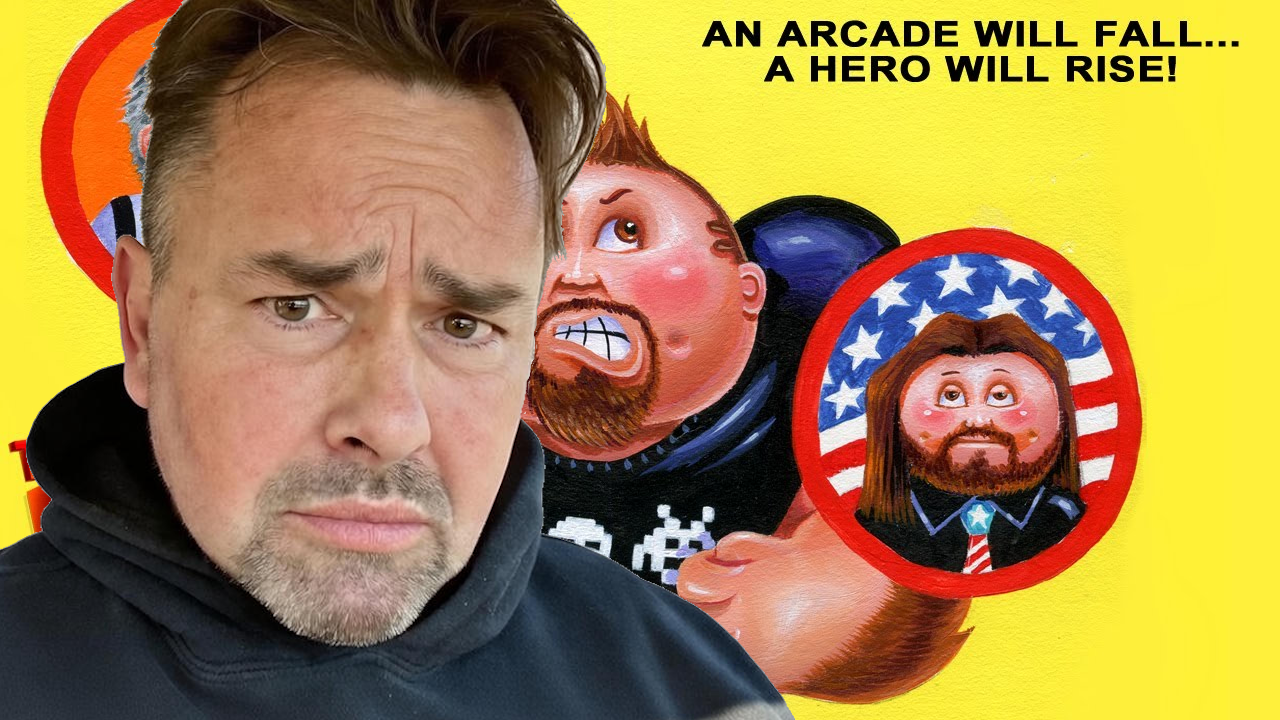

Richie Knucklez is a complex guy. First and foremost he’s a husband and father, but behind that he’s also a talented musician who’s toured the nation and a gamer with multiple world records. he’s also a guy with big ideas and even bigger determination. Richie took what could have been a catastrophe when a basement flood damaged his many arcade cabinets and turned it into one of the most popular arcades in the country. Not only that, he turned it into one crazy story.
In Richie’s documentary The King of Arcades, he takes viewers along on his journey. What it took to fulfill a dream, what it took to keep it, how it felt to lose it, and what it took to take it back. Now, ten years later, Justin caught up with Richie to see what he’s up to now, and how the experienced changed him.
It’s been about ten years since King of Arcades was released — how does it feel revisiting that chapter of your life?
Well, watching it now is a huge throwback for me, especially because of my daughter Faith. At the time, she was my little baby — my partner in crime. She drove with me to pick up games. I was a stay-at-home dad. I ran the arcade with her. Every single day I worked, she was right there with me.
So whenever I watch it, it takes me back to when she was little. Now she’s 19 and in college. Watching it brings up that empty-nest feeling. More than anything, it reminds me of being a dad, how much I miss that time, and how much I miss owning a successful arcade.
It’s nostalgic, but it also hurts. I don’t have an arcade anymore. Sometimes I feel like a failure because I’m selling off most of my collection now. At the same time, it feels good knowing I was one of the first people to do this. When I opened, there was Ground Kontrol, Funspot, and Ghalloping Ghosts — that was about it.
Now you see arcades everywhere. The Game Vault in Morristown, for example — when I first opened, Dave from Game Vault was a customer. He’d come in and talk about opening his own arcade someday. Seeing people who came in, watched what I did, copied what I did, and opened their own places — there’s pride in that. But there’s also that feeling of wishing I was still there.
Yeah, right — still living the dream in a way.
Yeah. Part proud, part failure.
When you watch the film now, when you go back to it from time to time, do you still see the same person on screen, or someone who’s changed?
Oh my God, I’ve changed so much. At the end of King of Arcades, I was going through a divorce. That was the silent thing that wasn’t spoken about in the movie. The Kong Offs took a huge toll on my marriage.
I was a one-man operation. When we actually ran the Kong Offs, I had help during the events — people helped with streaming and logistics — but the preparation was just me. I had 22 Donkey Kong machines to prep. I drove all over the country to acquire them. My ex-wife couldn’t handle me not being around.
I brought my daughter everywhere with me, and I focused more on being a dad than being a husband. We divorced. After that, I went through a really dark period.
Now I’m remarried to someone who’s into this world. She’s wonderful. I finally have a true partner. I’m a totally different person now — not in a bad way, just more grounded, more humble. Being a dad is still the most important thing to me.
I’m still completely into this. I still go for world records. I still play all the time. I have about 50 or 60 arcade games in my basement — the ones I’ll never get rid of. We were playing just yesterday.
Oh wow, that’s awesome. So it’s basically like your own mini arcade for you and close friends.
Yes. And my wife really enjoys it. I have an original Pong machine and a diner pinball machine in the kitchen. That tells you how into it she is.
That’s great. It really helps to have a partner who appreciates what you appreciate and understands your life’s journey. Do you feel the film accurately captured who you were at the time?
Yeah — exactly who I was at the time. I was kind of crazy. Running around nonstop, trying to make my mark in the arcade world, trying to change the stigma that arcade gamers were just nerds.
I wanted to make competitive gaming exciting again with the Kong Offs. I wanted Twin Galaxies to be respected instead of laughed at. I was trying to accomplish a ridiculous amount on my own. And yeah — it took a toll on my marriage.
How did the documentary change your life in ways you didn’t expect? You may have already answered this a bit, but did it affect things in ways you didn’t anticipate?
Yeah, it definitely contributed to my divorce. My wife hated the documentary. She hated being filmed for three years. That absolutely added to the marriage ending.
Other than that, it mostly helped promote the Kong Offs. It didn’t change my life much beyond that. But it did make me recognizable. When I go to events now, people come up to me and say hello — that wouldn’t have happened without the film.
That actually answers my next question. How do people approach you today compared to right after the film came out?
People come up and say they saw the film on Hulu or wherever. Because it’s on so many streaming platforms now, I probably hear from someone about it once a week. People tell me they didn’t expect to like it, but it really hit them.
Arcade culture has evolved a lot over the last decade. From your perspective, what’s changed the most?
The explosion. When I opened my arcade, people told me I was nuts. I doubted it myself. Now every city has a classic arcade, some open 24/7.
There were no barcades when I opened. The Brooklyn Barcade didn’t even exist yet. Watching it explode the way it did — I never could have predicted it.
So where do places like Dave & Buster’s fall for you? Do you consider that an adult arcade?
No. I love Dave & Buster’s, but it’s a different animal. I’m talking about mom-and-pop arcades with classic games and pinball.
Do you think younger generations connect with arcades differently now?
I think it depends on the parents. Some kids get it, some don’t. But when I visit arcades now, I see a lot of young kids playing. From what I’ve seen, the younger generation is embracing it, and that’s great.
When you sell machines now, are you selective about who you sell to? Arcades only, or anyone?
When you’re trying to keep a kid in college and a roof over your head, you sell to anybody.
Do you see a lot of people buying them for home game rooms or man caves?
Oh yeah — definitely.
If you could talk to your younger self from the film, what advice would you give him?
Don’t expand so fast. I opened three arcades at once. I had close to 400 games in storage at one point. Financially, that killed me.
Has your definition of success changed since the film?
No. Being a great dad, being a good husband, supporting the people I love, and doing what I love every day — that’s success to me.
What do you hope King of Arcades represents now, ten years later?
That if you follow your dreams and work hard at what you love, you can build something meaningful. I’m still learning every day. I’ve recently had to teach myself how to fix every kind of monitor because CRTs aren’t being made anymore.
I refused to switch to LCDs. I had 30 empty cabinets and only two working monitors left. So I spent weeks studying, buying tools, learning. Now I’ve got nearly 30 working monitors as backups.
So at this point, are you basically the go-to guy for repairs?
That’s my side business. I do house calls and repairs. I call it Just The Fuse Arcade Repair. Everyone says, “It’s probably just a fuse,” even though it never is.
Do you feel responsible for keeping arcade culture alive?
I wouldn’t say responsible — but I definitely had a hand in it, and I’m proud of that.
If the film were made today, what do you think it would focus on?
Restorations. Finding broken games, restoring them properly, and seeing the reaction when someone gets their dream machine. That would make a great TV show.
Any chance of that happening?
Only if someone in the industry gets excited again. I keep a low profile now.
I just want to say, I’m a huge fan of the movie. I’ve watched it multiple times, and revisiting it now gives it even more meaning. Thank you for taking the time to reflect on it.
It’s crazy, but arcade games have been the one constant in my life. My love for them hasn’t faded at all.
And it shows. Thanks again, Richie.
GamesRelated would like to thank Richie Knucklez for taking time to chat with us. His contributions to the video game industry are still being felt today with the rise of home arcades, and his impact on gaming will be felt for years to come.
